My friend Sarah made me a necklace.
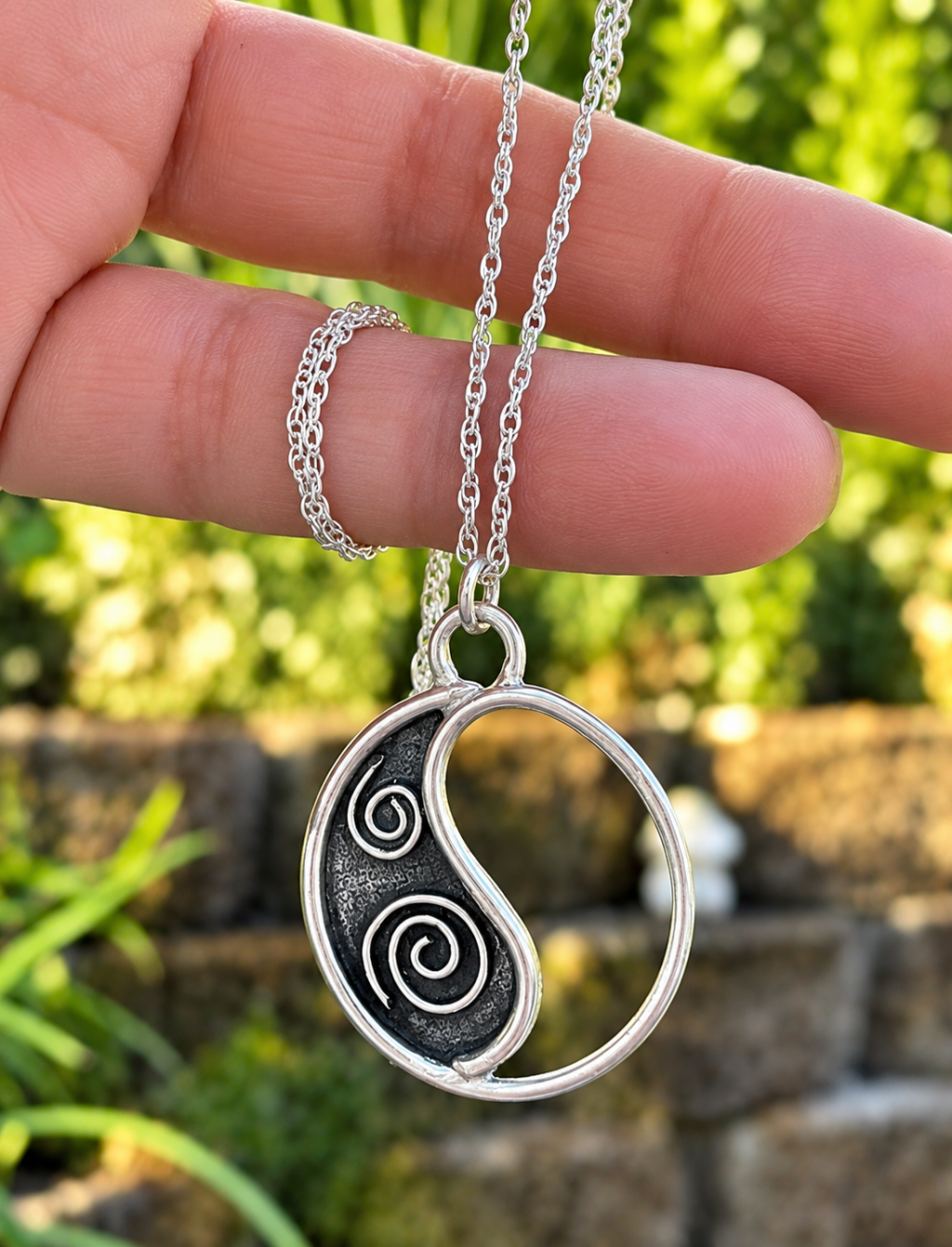
I had ordered a yin yang pendant from her weeks ago and given her no explicit direction at all. No sketch, no Pinterest board, no color preference. I simply knew Sarah. I’ve known her for years, and I know her heart is full of love, compassion and empathy. Something in me trusted that whatever she made would carry that.
When the image photo came through last night, I was nearly speechless. She had given me more than I would have asked for, because even I didn’t know what I wanted conveyed until I saw it in her hands. She had no background in Taoist philosophy. She simply followed her own instincts. And what she made was more accurate than anything I could have specified.
That, it turns out, is exactly how yin and yang work.
What Yin Yang Actually Means
Most of us in the West have heard the term. We’ve probably assigned it a meaning too, something like balance, or opposites, light and dark, good and bad. Few of us have taken the time to sit with what it actually says.
Yin and yang aren’t opposing forces competing for territory. They’re two aspects of a single whole, defined only in relation to each other. The word yin originally described the shaded side of a hill. Yang described the sunlit side. Same hill. Two conditions, depending on where the sun sits.
Yin is the receptive, still, inward quality. Yang is the active, moving, outward one. Neither is superior. Each carries a seed of the other, which is why the traditional symbol shows a small dot of the opposite color tucked inside each half. Push yang far enough and it becomes yin. A season of relentless motion eventually collapses into stillness, whether we choose it or not.
But there’s a piece most of us miss entirely when we hear the word balance. We picture two solid halves pressed against a straight line down the middle. The actual line is a curve. A wave. It moves. And that wave has a name: wu wei, often translated as non-action, though it means something closer to action that doesn’t force. Living inside that wavy line, following where it moves rather than planting a flag on one side, is the practice most of us skip. We tend to live entirely in yin, or entirely in yang, and rarely notice the flowing place between them where the real teaching lives.
I know this because I lived it. Both extremes.
The Yang Years
I spent most of my childhood in a state of yang.
My mother struggled with alcoholism, and my father’s counsel to me was simple: be a good girl, stay out of your mother’s way, and she won’t drink. I was a child. I took that instruction and built a survival strategy out of it. If I could just stay busy enough, be good enough, cheerful enough, maybe I could prevent the thing I was afraid of. I made myself responsible for a problem that was never mine to solve.
Walking home from school, I’d feel a familiar rising panic. Would she be drunk when I got there? That fear set the machinery in motion. Stay alert. Stay useful. Paint sunshine over everything, because if the house looked calm, maybe it would be.
That sunshine was pure yang. Constant motion pointed outward, covering something that was never allowed to be looked at directly.
Later in life I learned I’m autistic, and I could see how that same instinct toward managing appearances had folded into masking. Years of performing the expected response, suppressing the natural one, staying one step ahead of how I might be perceived. More yang stacked on top of yang, until it was hard to locate where the performance ended and I began.
It took Covid, and later, my diagnosis, to see clearly what had been stirring underneath all those smiles the whole time. Grief that had never been allowed to surface. Fear that had never been named. A body and mind that had been running the same threat assessment since childhood, decades after the actual threat had ended.
The Yin Years
Once I saw it, I did what many of us do. I overcorrected. I flipped entirely into yin.
Through insight meditation, I began exploring stillness, silence, withdrawal. This season served a real purpose. It gave me room to finally feel the pain I’d outrun for so long, and to start releasing the unskillful habits I’d learned about handling it. Yin, at first, was medicine.
But left unchecked, yin can curdle too. What began as needed rest slowly became avoidance. Stillness that had been healing started to feel more like disappearing. The diagnosis that helped me understand myself also became, if I’m honest, an excuse to stay quiet longer than the moment actually required.
Two seasons, two extremes. Constant motion, then constant retreat. Neither one, on its own, was the whole truth.
Living on the Wavy Line
What I’m working toward now isn’t a return to yang, and it isn’t a deeper settling into yin. It’s learning to live in that curved, moving line between them, the place wu wei describes. Not striving toward an outcome. Not withdrawing from one either. Responding to what’s actually here.
This is where equanimity, upekkha in the Pali language (pronounced oo-PEK-kah), becomes essential. Equanimity isn’t detachment. It’s the steadiness that lets you meet whatever is arising, action or stillness, speech or silence, without gripping either one as identity. Some days call for yang. Some days call for yin. Peace comes not from choosing correctly, but from staying present enough to feel which one the moment is actually asking for.
The line between yin and yang was never a solid wall. It’s a wave, always moving, and I’m learning that home is found in that motion, not on either side of it.
Back to the Necklace
Sarah had no direction from me, and yet she placed two concentric spirals inside the yin half of the pendant.
I sat with that image for a long time. Spirals don’t return to the same point. They turn back through familiar territory, but never land in quite the same place twice. That’s what these years have felt like, folding and unfolding the same lessons again and again, each pass carrying something the last one didn’t. The spiral is also a quiet picture of arising and passing away, the way each moment of fear, or stillness, or sunshine, comes forward, has its time, and gives way to the next.
She didn’t know any of this when she shaped the wire. She just knew me, and she followed what felt true. Which may be the clearest demonstration yet of what this whole philosophy is pointing toward. The pattern was already there, waiting. She simply had the presence to let it come through her hands.
A Question for You
Where are you right now?
Are you living in a season of yang, moving constantly, managing, performing, staying one step ahead of something you haven’t looked at directly? Or are you in a season of yin, withdrawn, quiet, perhaps mistaking retreat for peace?
Or maybe, on your better days, you’re finding that wavy line in between. Not gripping either pole. Just flowing with what life is actually asking of you in this moment.
Whichever one it is, there’s no need to rush past it. Every season, even the ones we didn’t choose, has something to teach us on the way to the center.
Jan
PS. Love Sarah’s work and want your own custom piece designed? Check her out on Instagram @polokajewelry_sarahlizzie
Jan Wood is an author, mindfulness guide, and lover of life, based in Baker City, Oregon. Through Prem Valley Mindfulness, she offers personalized mindfulness coaching grounded in practical, everyday practice — for those navigating stress, chronic illness, or simply the beautiful complexity of being human. If you are curious about working together or exploring the daily practices offered on the site, she would be glad to hear from you at premvalleymindfulness.com.

Leave a comment