
Alan Watts once made an observation that has stayed with me. Traveling across America he noticed something paradoxical —a society that calls itself materialistic but demonstrates almost no genuine care for material things. Broken down cars in driveways. Tools rusting in yards. Neighborhoods that look like decade-long collections of abandoned intention.
‘We don’t value matter’, Watts said. ‘We consume it’.
Years ago Larry and I read Your Money or Your Life by Vicki Robin and Joe Dominguez. We were living in a big city, dreaming of something simpler, but convinced we couldn’t afford it. The book introduced a clarifying concept —calculating the true hourly value of your income once you subtract what it costs to maintain that income. The commute. The car. The clothes required to look the part.
When we ran the numbers, the gap between what we claimed to value and how we were actually living became impossible to ignore.
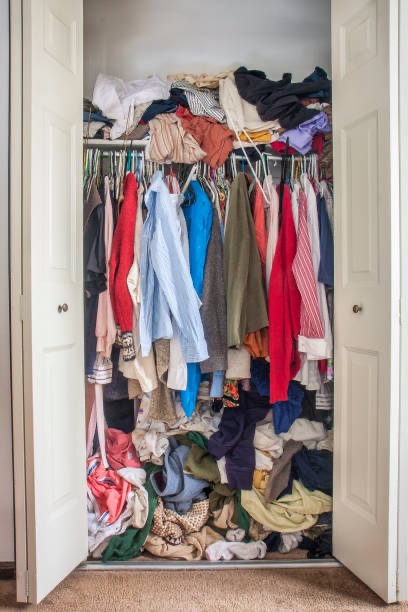
One passage stopped me cold —Vicki cited the average number of coats owned by American women at the time, somewhere between six and eight. I’m sorry to say my own closet exceeded that by a significant margin. And forget about shoes.
What the Research Shows
Wellbeing studies consistently show that materialistic tendencies are linked to decreased life satisfaction, increased depression and anxiety, and reduced social connection. The traits associated with higher wellbeing look remarkably different —time with people we love, purposeful work, time outdoors, genuine community.
Research confirms that experiences bring more lasting happiness than material possessions. The trip taken. The meal shared. The conversation that changed something.
The Cost to the Planet
We hear a great deal these days about artificial intelligence as a potential threat to civilization. Researchers, technology executives and governments are actively debating whether advanced AI could ultimately pose an existential risk to humanity. The conversation is serious and worth taking seriously.
But AI may have a formidable competitor in the race toward civilizational harm —and that competitor is far more familiar. It looks like a rubbish truck full of clothing arriving in a landfill every second. Of the 100 billion garments produced each year, 92 million tonnes end up discarded. The average American generates 82 pounds of textile waste annually, buying 60 percent more clothes than twenty years ago and wearing them half as long. The fashion industry contributes 10 percent of global carbon emissions —outpacing international flights and maritime shipping combined.
The threat we’re waiting for may already be underway —one unreflective purchase at a time.
A Question of Alignment
One of the key factors of living a life without undue stress —as described in the Buddha’s path —centers on Right Livelihood. Earning and spending in ways that don’t cause harm to the world we share. Not deprivation. Alignment —bringing how we actually live into harmony with what we claim to care about.
The gap between stated values and lived reality is its own form of suffering. Quiet and chronic. The kind that hums in the background of a life that doesn’t quite fit.
Vicki Robin named it precisely: We no longer live life. We consume it.
Some Simple Starting Points
If any of this resonates as a concern for you, there’s simple things you can do. Before purchasing anything, wait 48 hours. Most urgency dissolves.
Walk through your home and identify what you own but no longer use. Give it to someone who will genuinely use it —a neighbor, a friend, a local thrift store.
Calculate your true hourly wage as Robin and Dominguez suggested. Then ask whether what you’re about to buy is worth that many hours of your life.
Tend what you have. Repair before replacing. Care for your possessions as expressions of care for the resources that produced them —and for the world your grandchildren will inherit.
The planet is not asking for our guilt. It’s asking for our attention.
Jan
Jan Wood is an author, mindfulness guide and lover of life, based in Baker City, Oregon. Through Prem Valley Mindfulness she offers personalized mindfulness coaching grounded in practical everyday practice. She would be glad to hear from you at premvalleymindfulness.com.

Leave a comment