
Alan Watts once pointed out something that stops you mid-thought: when we call someone materialistic, we have it exactly backward. A person who truly valued material things would treat them with reverence. They would slow down long enough to notice what something is made of, who made it, what it cost the earth to exist. That is not what we do.
What we practice is closer to its opposite. We accumulate, consume, discard, and upgrade, not because we love things, but because we barely see them. The wanting is everything. The having is almost beside the point. Watch children on Christmas morning and you’ll understand: the magic lives in the days before, in the anticipation, the imagining. Once the wrapping is off, the clock starts ticking toward the next want.
Larry and I lived this without quite naming it. Through years of moving and resettling, we gathered what felt, at each stop, like a life well-furnished. When we moved into a much smaller space, we had to look at all of it honestly. And what we found was that most of it had never really been ours in any meaningful sense. It occupied our rooms and our storage and eventually our attention, in the form of obligation. Finding it a home, hauling it away, or making room for it in a house where room was finite. It was only then that we could see how little regard we had actually shown these things we once thought we needed.
There’s an old joke: you never see a hearse pulling a U-Haul. The things we acquire may share our address, but they don’t belong to us in any permanent way. We are temporary stewards. That reframe changed something for us.
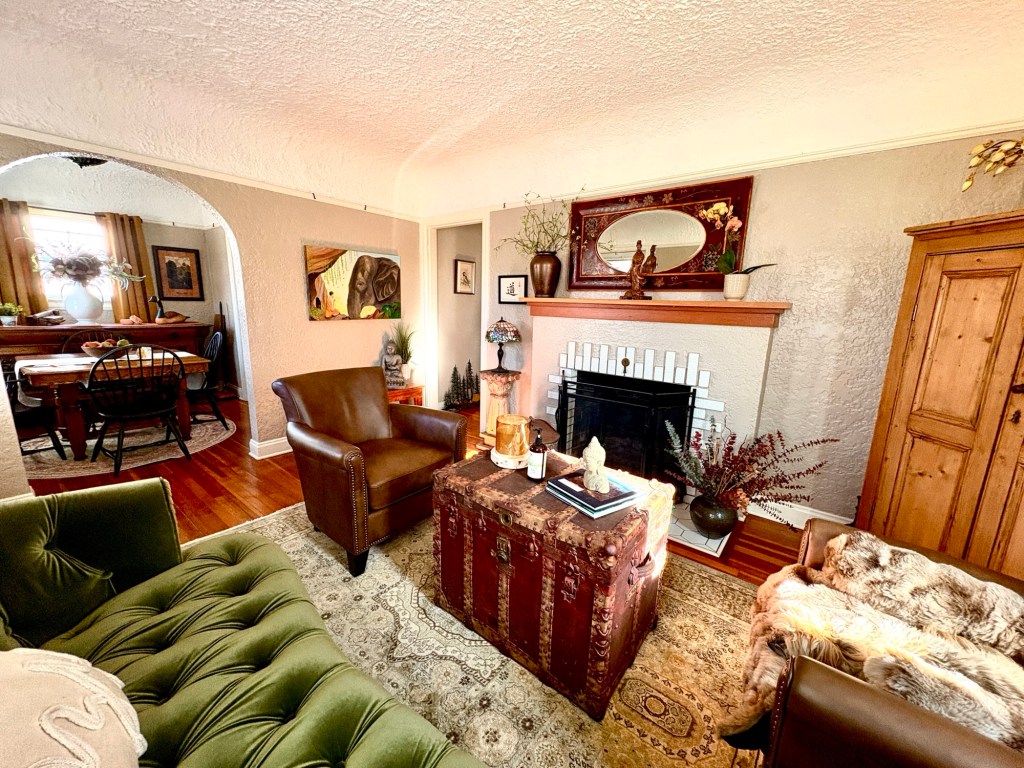
When we chose what came with us to Baker City, the question was simple: do we actually respect this? Not enjoy it, not use it, but respect it. The objects that made the cut were ones with stories we could tell. Handmade art. Furniture worn into dignity by time and use. Statues that point toward something larger than the room they sit in. Chairs where something shifts in us when we sit down. There is not a single object in our home today that we do not honor. In that sense, and perhaps for the first time, we have become genuinely materialistic.
This is the invitation Watts was extending. Not to own less for the sake of some minimalist ideal, but to actually see what we have. To ask whether we are in relationship with our things or simply warehousing them. The moment we began to treat our possessions the way we treat a forest or a river, as matter that deserves our attention and care, our whole relationship with acquiring changed. Saving began to feel more satisfying than spending. Choosing slowly felt better than choosing often.
The material world is not the problem. Our inattention to it is. If we were truly materialistic, we would walk more carefully on the ground beneath our feet.
So here is the question worth sitting with: Are you materialistic, or anti-materialistic? Do the things in your home hold stories you can tell, or have they simply accumulated around you? I would love to hear your thoughts in the comments.
-Jan💕

Leave a comment