
A few short years ago, at sixty-two, I was formally diagnosed with Autism Spectrum Disorder (ASD) and Attention-Deficit/Hyperactivity Disorder (ADHD), AuDHD. It was not a surprise. I had known it internally for decades, but having a name for it opened a doorway. Instead of masking my “odd” habits, as I had done most of my life, I finally had permission to see them clearly and welcome them.
My mindfulness practice opened a second doorway. It gave me language for the way my brain processes information and, more importantly, the space to meet those patterns with acceptance rather than resistance. Through meditation, I began to understand that my habits were not failures of discipline or quirks to hide. They were signals, regulation tools, and sometimes even invitations into presence.
Recently, I noticed one of those invitations again.
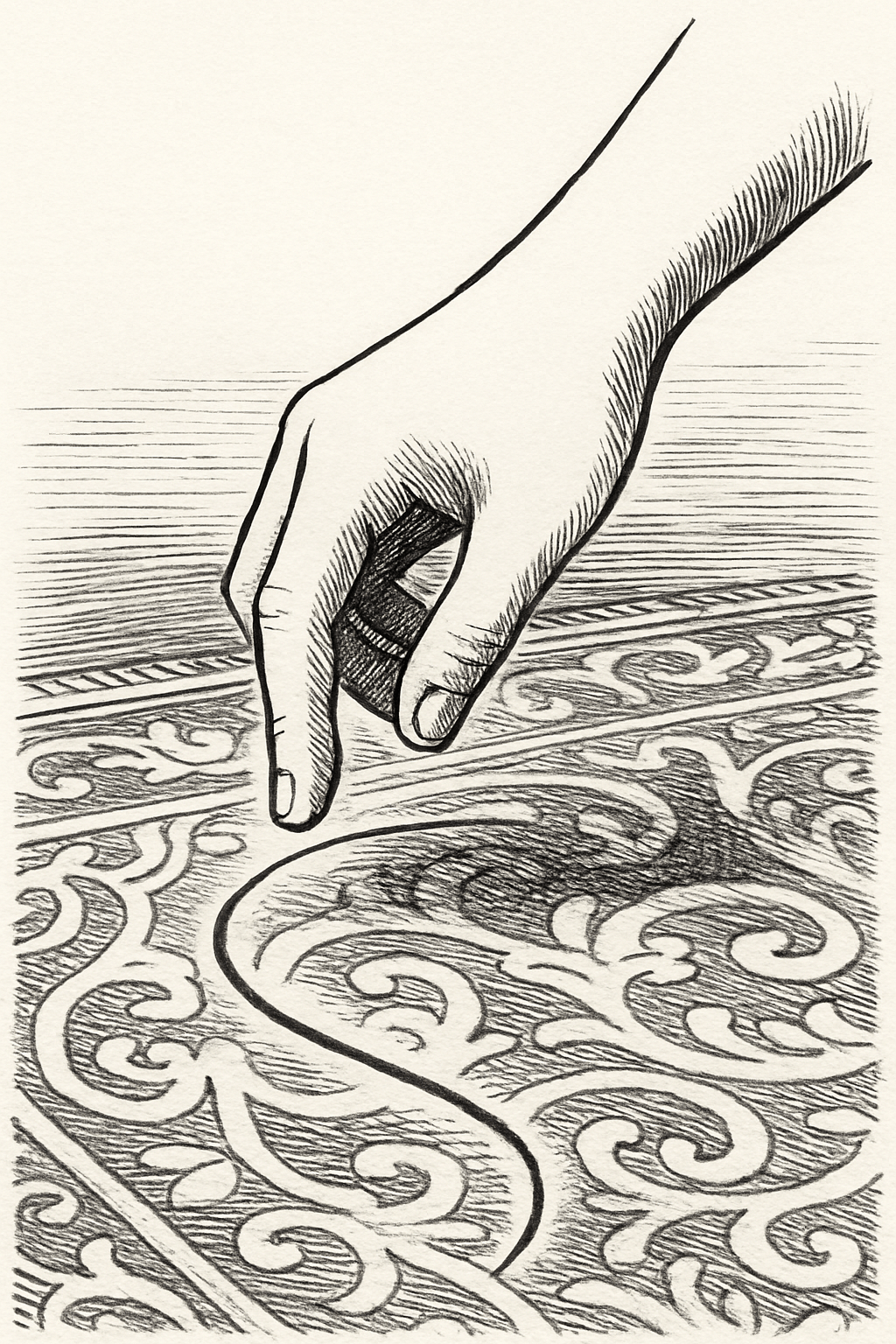
Many of us with OCD or repetitive stimming behaviors already move in ways that are rhythmic and absorbing. When my finger traces a pattern in the carpet, I recognize the familiar pull. And instead of trying to stop it, I have begun to use it.
By bringing awareness to the movement, the tracing becomes a meditation anchor, the same way the breath or footsteps can be. The compulsion shifts from something I must fight to something I can work with.
In the case of tracing a pattern in the carpet, the mind settles almost naturally. By meeting the movement with awareness rather than resistance, I can deepen my practice in real time. I am not pulled toward the experience or pushed away from it. The internal commentary quiets. What remains is direct contact with the movement itself.
In that moment, the tracing is not something I am doing to the pattern. It becomes a single, continuous experience. My attention rests where the finger follows the imagined line, and the separation between “me,” “the movement,” and “the pattern” drops away. I am simply present for what is happening. No effort. No interpretation. Just the experience unfolding as it is.
Why This Matters
1. It interrupts the struggle cycle
Trying to shut down a compulsion often intensifies it. Redirecting the movement into mindful attention dissolves that fight. The behavior no longer controls the moment. You do.
2. It transforms repetition into rhythm
Stimming is already rhythmic. Meditation is rhythmic. When the two meet, the conflict drops away. The movement becomes steady ground.
3. It builds present-moment stability
Mindfulness is not about forcing stillness. It is about noticing what is actually happening. When you stay with the tracing of a line or the tapping of a finger, attention settles into the now.
4. It reduces shame and increases agency
Receiving my diagnosis helped me release decades of masking. Choosing to use these behaviors consciously takes that acceptance further. What once felt like a flaw becomes a tool.
5. It blends regulation with awareness
Many stims are the nervous system trying to regulate itself. Adding mindfulness to the movement allows you to receive the soothing effect while also cultivating clarity and presence.
A Simple Practice
• Notice the beginning of a repetitive urge
• Instead of stopping it, choose to meet it with intention
• Feel the movement as it happens
• Let the motion set the pace
• Return to the movement whenever the mind wanders
This approach is not indulging OCD. It is repurposing the energy. It is using your own wiring as a legitimate doorway into mindfulness and greater self-understanding.
If you’ve tried something similar or want to experiment with this practice, share your experience in the comments. Your insight may help someone else.
-Jan

Leave a comment