How to Recognize Thought Patterns Before They Take Over
I woke up this morning and knew within a few breaths that my mind was heading somewhere dark.
It had been a full weekend. Heavy activity. Deep conversation. The morning light has shifted, and I woke to darkness instead of the soft wash of summer. My book is finished, which brings its own peculiar emptiness. I’m standing in that strange hallway called What’s next? The holidays are approaching and, once again, it will be the two of us.
Before I was fully awake, the thoughts were already working.
No one is coming.
You’re falling behind.
You should be further along by now.
A steady stream of unwholesome thought.
I could feel my mind tugging my emotional state down a narrow chute of defeat.
So what is actually happening here?
The Gift We’re Given at the Beginning
When we enter these bodies for the first time, it is as if we receive a remarkable gift.
We call it consciousness, simple, open awareness. At the beginning it is clear. Over time, it records. It pairs events with sensations, emotions, and meaning. It learns:
This is safe.
That is dangerous.
This is love.
This is loss.
Modern psychology tells us that our minds are not neutral. They are survival machines.
Researchers describe something called the negativity bias, the brain’s tendency to react more strongly to negative stimuli than to positive ones.
- Negative experiences create faster, stronger neural firing.
- We remember them more vividly.
- We revisit them more often.
(Baumeister, Bratslavsky, Finkenauer & Vohs, “Bad Is Stronger Than Good,” Review of General Psychology, 2001.)
From an evolutionary standpoint, this made sense: remember what can harm you. But today it often paints an ordinary morning in unnecessary shadow.
The mind is not attacking us.
It is doing exactly what it was built to do.
Why the Mind Rehearses Pain
Neuroscience also shows that the brain is constantly making predictions, comparing the present moment to stored memories and projecting what might happen next.
(Clark, “Whatever Next? Predictive Brains, Situated Agents, and the Future of Cognitive Science,” Behavioral and Brain Sciences, 2013.)
Something about today feels like something that hurt before… and the mind quietly says:
“I know this pattern.”
And it starts rehearsing the old pain.
You might hear:
This always happens.
You’ll mess this up.
You’ll be alone forever.
The intention is protection.
The effect is suffering.
In Buddhist language, the mind has slipped into unwholesome states, patterns rooted in fear, craving, or confusion that create distress.
The good news: we are not powerless inside this process.
Mindfulness: Changing the Relationship
Mindfulness is the practice of seeing clearly what is happening as it is happening, without being swept away by it.
Brain imaging studies show that mindfulness practice changes activity in the default mode network, the brain system associated with rumination and self-referential thinking.
It strengthens regions involved in emotional regulation.
(Brewer et al., “Meditation Experience Is Associated with Differences in Default Mode Network Activity,” PNAS, 2011.)
In simple terms:
- Thoughts still arise
- But we are less likely to fuse with them
- And more capable of seeing them as just thoughts, not truths, not commands, not fate
This is the beginning of freedom.
Joseph Goldstein and the Uninvited Guests
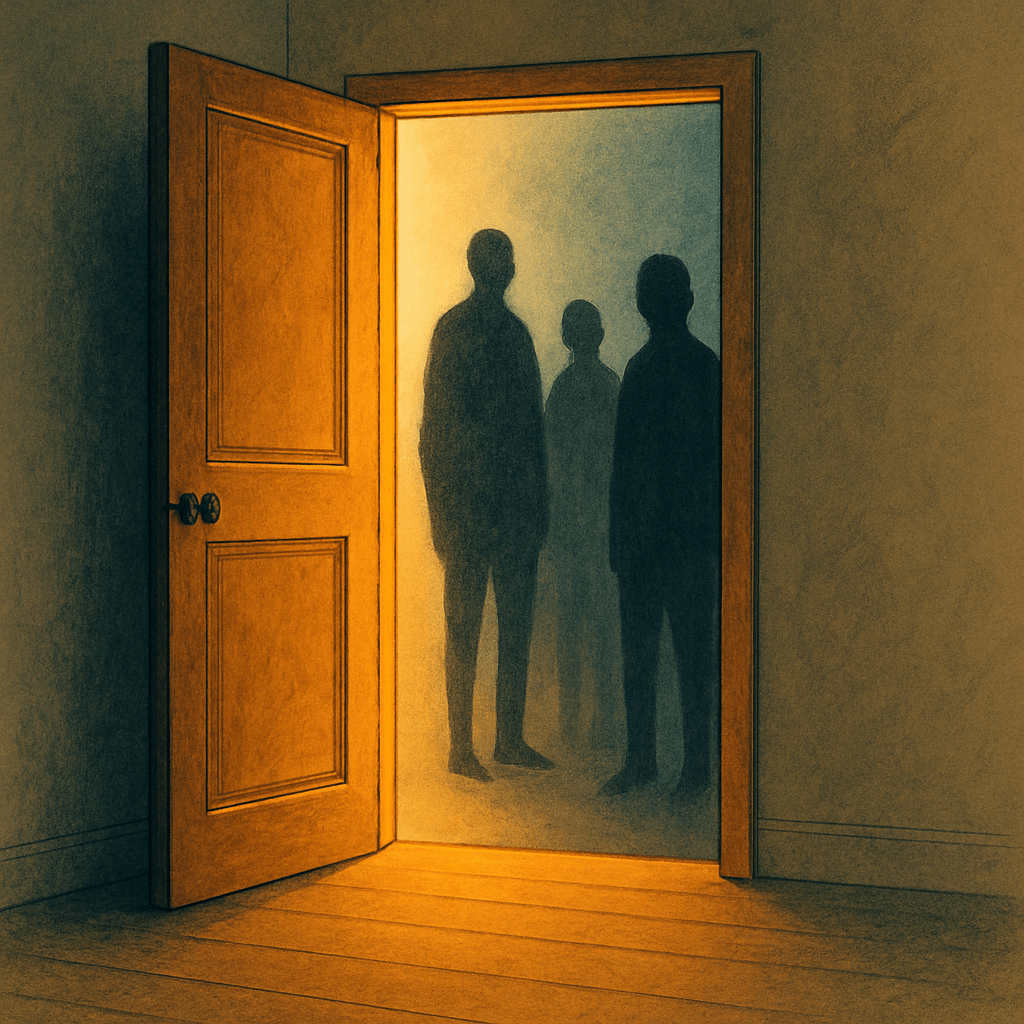
Insight meditation teacher Joseph Goldstein offers a teaching I return to often. He calls our thoughts uninvited guests.
They show up without warning.
They do not knock.
They do not ask permission.
Goldstein writes:
“Our practice is to recognize the uninvited guests of the mind. We do not have to feed them.”
(Joseph Goldstein, Mindfulness: A Practical Guide to Awakening, 2013.)
We have choices:
- We can invite them in, give them tea, and let them reorganize the entire house.
- We can slam the door (which rarely works).
- Or we can open the door, acknowledge them, and kindly show them out.
Sometimes I simply say internally:
“I see you. You’re predicting pain. Thank you for trying to protect me. I’m going to check what’s actually true right now.”
This reminds me that I am the host,
not the guest,
not the noise,
not the story.
A Simple Way to Meet Your Unwelcome Guests with Mindfulness
Here is a gentle practice to use the next time your mind starts marching toward a dark place:
1. Notice the shift.
“Ah. My mind is going somewhere.”
This recognition alone interrupts the autopilot.
2. Name the pattern.
“Worrying.”
“Old fear.”
“Negativity bias.”
Labeling reduces emotional charge.
(Lieberman et al., “Putting Feelings Into Words,” Psychological Science, 2007.)
3. Feel the body instead of the story.
Tight chest?
Heavy gut?
Fatigue?
Predictions soften when we return to sensation.
4. Choose your hospitality.
How long do I want this guest in my house today?
5. Turn toward something wholesome.
Breath.
Warm mug.
A phrase of kindness.
A small, nourishing action.
You don’t have to banish the guests.
You just don’t have to give them your whole morning.
Friend or Foe?
Joseph Goldstein summarizes it perfectly:
“The Buddha talked of how this mind, this force or power of consciousness, can be our worst enemy or the most benevolent friend.”
The same mind that rehearses old pain is also the mind that recognizes,
“This is just a visitor.”
The same mind that drags us into a dark hallway is also the mind that can turn on a light.
We may not control who knocks on the door each morning.
But we absolutely have a say in how we meet them.
-Jan


Leave a comment