
Or, “I Thought I Was Practicing Self-Care. Turns Out, I Was Practicing Insomnia.”
For years, I believed I had the perfect bedtime ritual.
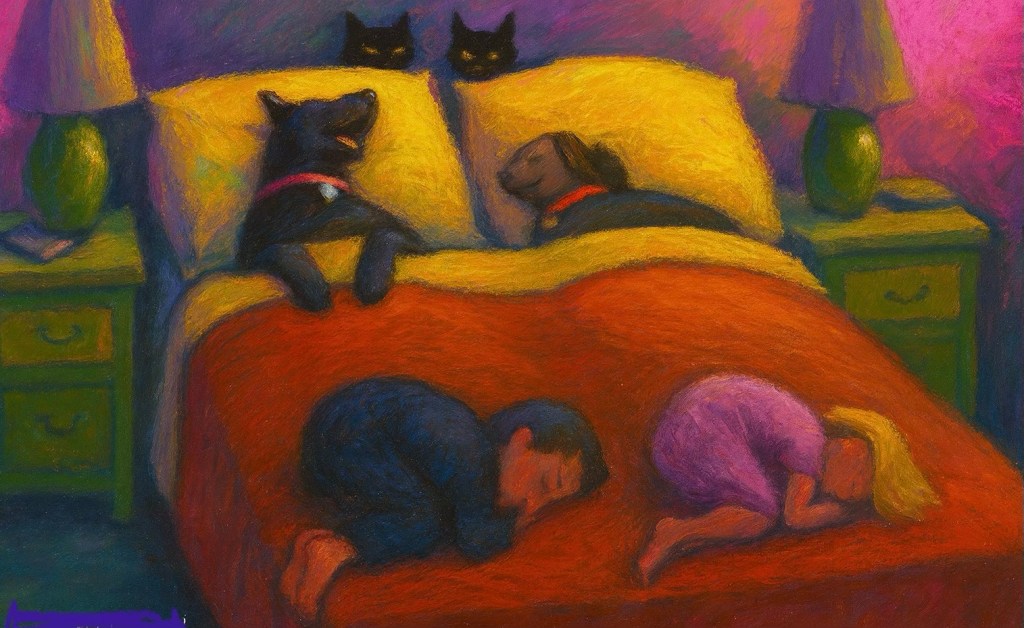
TV until 10. Phone until 11. Fireplace blazing like a luxury lodge. Weighted blankets, flannel sheets, and a room warm enough to grow orchids. Two dogs, two cats, one husband, and a CPAP machine.
I told myself this was comfort. Science calls it chaos.
My husband, a type-1 diabetic, slept beside his insulin pump and its chorus of 3 a.m. alarms. My CPAP hummed like a friendly droid. One cat claimed the pillow; the other prowled the foot of the bed. The dogs, meanwhile, began their nightly thirty-minute circle ritual, spinning and sighing in search of the elusive “perfect spot.”
We thought we were nurturing closeness. In truth, we were perfecting the art of interrupted sleep.
The Great Bedroom Divorce (With Love and Pillows)
Eventually, we made the unconventional decision to create separate sleeping quarters—not out of conflict, but compassion.
We realized that sometimes love rests better when it has its own room.
Now we each get a dog, and the cats, ever democratic, choose their room nightly. At first it felt odd. I missed the rhythm of his breathing (and he missed my CPAP’s occasional Darth Vader impressions). But mornings soon brought a quiet joy neither of us expected:
We could ask, “How did you sleep?” and, for the first time in years, have no idea how the other actually did. That small mystery feels tender, almost luxurious.
When “Comfort” Becomes the Enemy of Sleep
What I thought was nurturing turned out to be a perfect example of how modern life undermines rest.
“Even ordinary room light before bed suppresses melatonin and delays circadian timing.” — Harvard Medical School Sleep Study
• We’re sleeping less. Only about one in four Americans now gets eight hours a night. In 1942, more than half did.
• Light at night confuses the brain. Exposure to moderate room light can shorten melatonin release by up to 90 minutes. That glowing phone isn’t innocent—it’s broadcasting daytime to your nervous system.
• Screens double the impact. Blue light delays melatonin; scrolling fuels dopamine. Both keep the brain on alert.
• Temperature matters. Ideal sleep happens between 65 and 68 °F (18–20 °C). My 70-degree room with a roaring fire? Essentially a wellness-branded sauna.
• Pets are lovable disruptors. Studies show dogs in the room can calm us, but dogs in the bed reduce deep-sleep time. The cats, naturally, declined peer review.
Mindfulness: The Missing Link Between Calm and Sleep
Once the environment improved, I discovered my mind hadn’t. The lights were dim, the house was quiet—but my thoughts were still scrolling.
That’s where mindfulness entered. It’s not a sleep aid; it’s a way of teaching the body that rest is allowed.
Each night, I give myself ten minutes to unwind consciously:
1. Box Breathing
It’s simple physiology.
• Inhale for a slow count of four.
• Hold for four.
• Exhale for four.
• Hold again for four.
This pattern signals safety to the nervous system. It balances oxygen and carbon dioxide, slows heart rate, and tells the body, “You can stand down now.”
If the mind drifts, gently begin the next box.
2. Noticing Practice
After breathing, I shift attention to the senses.
• Three sensations in the body (the weight of the blanket, the cool air on my face, the rise and fall of breath).
• Three thoughts passing through (no analysis, no argument).
• Then a small note—just one line—for whatever the mind insists must not be forgotten. Writing it down lets the body release the task.
3. Compassionate Permission
When wakefulness lingers, I remind myself: I’m not failing at sleep; I’m practicing rest.
That phrase changes everything.
Research supports this. A JAMA Internal Medicine study found that mindfulness training improved sleep quality more than standard sleep-hygiene education, reducing insomnia, fatigue, and depressive symptoms. It helps by lowering pre-sleep arousal, the mental “fight-or-flight” that keeps us wired even when exhausted.
A Mindful Evening Routine (Tested by Humans and Cats)
Three hours before bed
Finish dinner. Dim lights one level. Avoid caffeine and heavy meals.
One hour before bed
Silence notifications, set devices aside, switch to warm light only.
Ten-minute wind-down
Practice box breathing, then the noticing exercise above. End by thanking the body for carrying you through the day.
Bedroom environment
Cool. Dark. Device-free. One dog per human. Cats freelance.
The Takeaway
True self-care isn’t always indulgent. Sometimes it’s subtractive. It’s learning to remove what agitates so the body can remember what peace feels like.
Our separate rooms became shared rest. We wake up refreshed, kind, and curious again—each morning beginning with the sweetest mystery:
“How did you sleep?”
“You’ll have to tell me over coffee.”
Sleep deprived no more,
Jan
🗣 Share your “sleep sabotage confession” in the comments. What’s one bedtime habit you thought was self-care?

Leave a comment