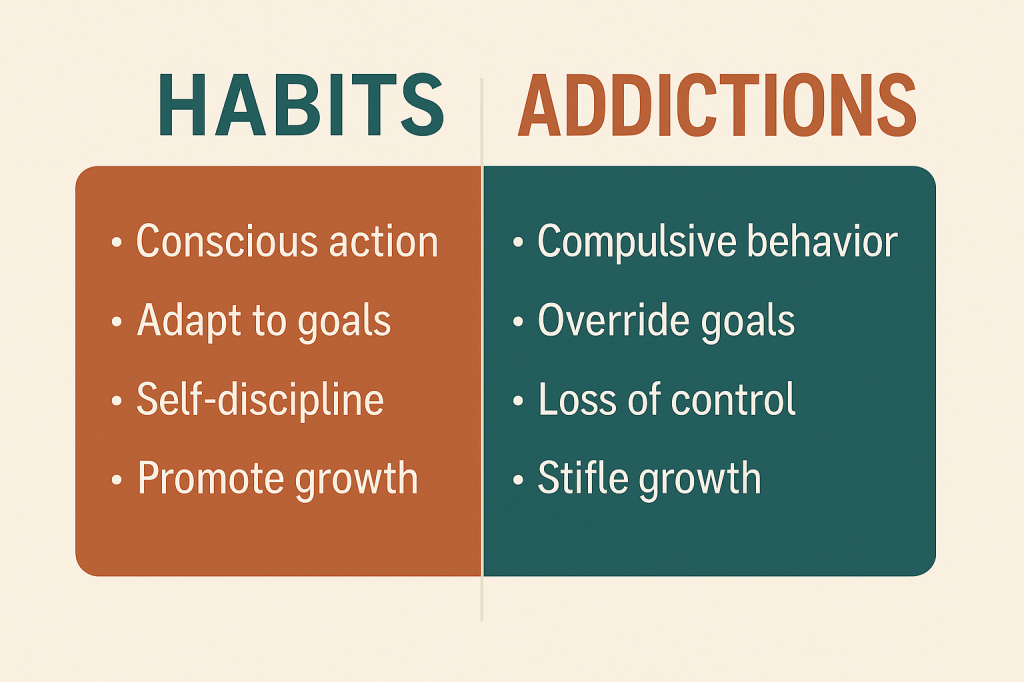
What if the routines we call healthy habits are simply a kind way of maintaining addiction?
Questioning the Question
There is no shortage of best-selling titles encouraging us to build better habits. Wake early, journal, meditate, work out, repeat. These routines can be helpful. But ask yourself:
Can you easily say no to one of your established habits?
If you skipped your morning workout, your daily meditation, or your nightly scroll through social media, how would you feel? Rested and relaxed, or uneasy and anxious? If the idea of pausing a habit feels uncomfortable, maybe it’s not a habit at all. Maybe it’s an attachment in disguise.
On Habit Formation and the Unseen Side
Habits relieve friction. They reduce decision fatigue and give us a sense of control. We tell ourselves, “This habit helps me be my best self.”
But beneath the surface of many “healthy habits” lies a subtle cultural push: self-care. And self-care, when unchecked, can shift from nurturing to ego-maintaining or people pleasing. We start identifying with the habit. “I’m the one who always eats clean.” “I never miss a day at the gym.” “I meditate every morning.”
There are hundreds of books on habit formation. The Power of Habit by Charles Duhigg explores the cue-routine-reward loop. Atomic Habits by James Clear focuses on identity-based micro changes. These are valuable frameworks, yet few ask a deeper question:
Are these habits serving freedom and presence, or are they reinforcing the story of “me,” the one who must always improve to look better for myself and others?
Experimenting with Non-Self-Care
Try an experiment. Choose a habit you believe is skillful. Then stop doing it for a short time.
What happens inside you?
Do you feel restless, guilty, or uneasy?
Do you notice a need to justify why you stopped?
That is valuable data. It reveals whether your habit supports your being or your ego.
As Jon Kabat-Zinn writes,
Meditation is the only intentional, systematic human activity which at bottom is about not trying to improve yourself or get anywhere else, but simply to realize where you already are
And Sharon Salzberg reminds us,
The moment that we realize our attention has wandered is the magic moment of the practice. Instead of judging ourselves, we can be gentle with ourselves.
Both teachers point to the same truth: freedom arises not through control, but through awareness.
So rather than building more habits, what if we changed the narrative? Instead of asking, “How can I improve myself through good habits?” we might ask, “What arises naturally when I am mindful of my actions?”
Let the breath lead. Let awareness show you what belongs and what does not.
From Habit to Presence
Here’s a simple practice:
Identify one habit you think of as healthy. Ask whether it serves your presence or your ego story. Pause it for a day or a week. In its place, rest your attention on your breath. Notice what arises without judgment. Journal what you learn. When you return to the habit, bring full awareness to it. Let it support your being, not define it.
This is not about rejecting all habits. It’s about observing which ones serve freedom and which ones create attachment.
Returning to the Question
Are your habits a kind way of expressing your addictions?
Maybe.
The answer is not found in doing more, but in seeing clearly. Habits can either liberate us or trap us, depending on the awareness we bring to them. Practice non-self-care for a while. Let stillness replace striving.
Notice what happens when you stop trying to be better and instead rest in what already is.
Call to Action
Today, pause one habit. Sit quietly. Feel your breath. Notice what surfaces when you are not “doing.”
When you return to your routines, let them rise from mindfulness, not maintenance.
Your being is greater than your habits. When the mind is unmoved, freedom becomes possible.
Jan💕

Leave a comment