
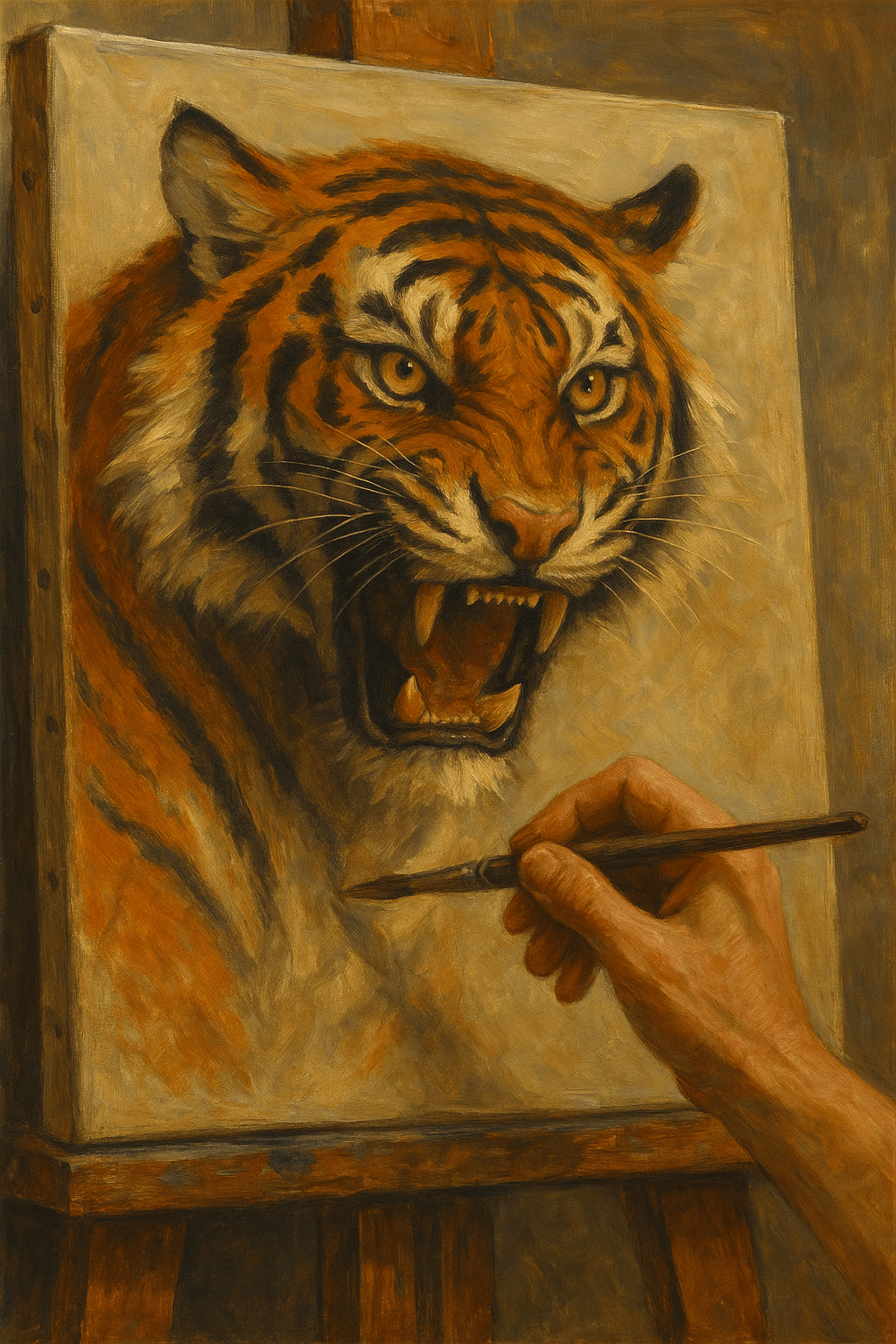
When Joseph Goldstein speaks about fear, he often invokes a vivid image from Zen lore, the painted tiger.
A monk once painted a tiger so lifelike that when he stepped back to admire his work, he became terrified of it. Goldstein says,
“We paint pictures in our minds of what will be, and then become frightened of our own imaginings. … When we see this happening, it may be useful to note, ‘Painted tiger.’ We don’t need to buy into the fear.”
Most of us spend our lives surrounded by these painted tigers; imagined threats, old stories, or internal voices warning us of what might go wrong. We respond to them as if they’re real. Mindfulness asks something radical of us: not to destroy these tigers, and not to nurture them either, but to see them clearly and relate to them with compassion.
Why We Paint Tigers
Goldstein teaches that fear arises whenever life approaches the edge of what we’re willing to be with.
“Fear shows us the boundary of the mind’s comfort zone. It’s where we stop trusting.”
— Joseph Goldstein, Fear, Pain, and Trust, Barre Center for Buddhist Studies
Our painted tigers often come in familiar forms:
Anticipation. We fear not what is but what might be. The mind spins a story, and we suffer inside the picture we just created. Self-image. We fear failure, rejection, or exposure, all versions of “not being enough.” Avoidance. We fear pain, loss, or death, so we push them away. Ironically, that very pushing keeps fear alive.
Each tiger we paint becomes part of the landscape of our life until we learn to meet it differently.
Befriending, Not Feeding
Goldstein often reminds us that lovingkindness toward fear is not the same as indulging it.
“Even though fear is present, it does not have to limit us. We can act anyway if we’ve developed this ability to be accepting of the fear.”
Mindfulness invites us to extend compassion to our fear without identifying as fear.
We might silently say:
“I see you, fear. Thank you for trying to protect me. You may rest now.”
This simple acknowledgment breaks the spell. The painted tiger softens back into brushstrokes, colors on canvas rather than claws in the dark.
Practicing with Painted Tigers
Here’s a way to bring this reflection into your own practice:
Recognize the tiger. When fear arises, pause. Note it gently: “Fear, fear.” See if you can locate it in the body; tightening, pulsing, holding. Name it with kindness. Instead of saying ‘I’m afraid’, try ‘Here is fear’. This small shift turns identification into observation. Offer compassion, not fuel. Breathe softly into the space around the fear. Imagine placing a warm hand over the heart. Stay a moment longer. As Goldstein teaches on retreat, experiment with “playing at the edge.” Sometimes the fear releases simply because you stop running. Notice its impermanence. All sensations, even fear, arise and pass. As you observe, ask: What is the nature of fear when seen clearly?
In time, you’ll discover that awareness itself remains untouched, vast, still, and capable of holding even the fiercest tiger.
From Painted to Present
Fear is not the enemy of awakening; it is often the threshold.
Each painted tiger shows us where the heart longs for understanding. When we meet fear with curiosity instead of resistance, we reclaim the energy we once spent defending against it.
As Goldstein writes,
“We gain insight into the impermanent, selfless nature of experience … we see that what we call pain is a constellation of physical sensations changing moment after moment.”
The next time a painted tiger prowls across your mind, pause before reacting. Look closely at its stripes, its shape, its color, the work of your own imagination.
Smile softly, bow in recognition, and remember:
You are not the tiger. You are the one who sees.
Be well painters!
Jan
Further Listening & Reading
🎧 Insight Hour Podcast Ep 87 — Metta and Fear 📖 “Fear, Pain, and Trust” — Barre Center for Buddhist Studies 📚 “On Fear” — Inquiring Mind Interview 🕊️ “The Nature of Fear” — Lion’s Roar Magazine

Leave a comment